Monthly Housing Market Update
Caleb's Perspective on the Market
After a few years of relatively sluggish conditions, the Victoria real estate market may finally be showing some signs of strength. Sales increased noticeably in August, while the growth in housing inventory has slowed to almost nothing. Those are both encouraging developments. But, as is often the case in real estate, there are winners and losers underneath the headline numbers. Right now, most of the strength appears to be concentrated in the single-family detached market.
Let's dig into the numbers.
Sales Are Picking Up
 Residential Sales: 567
Up by 13.4%
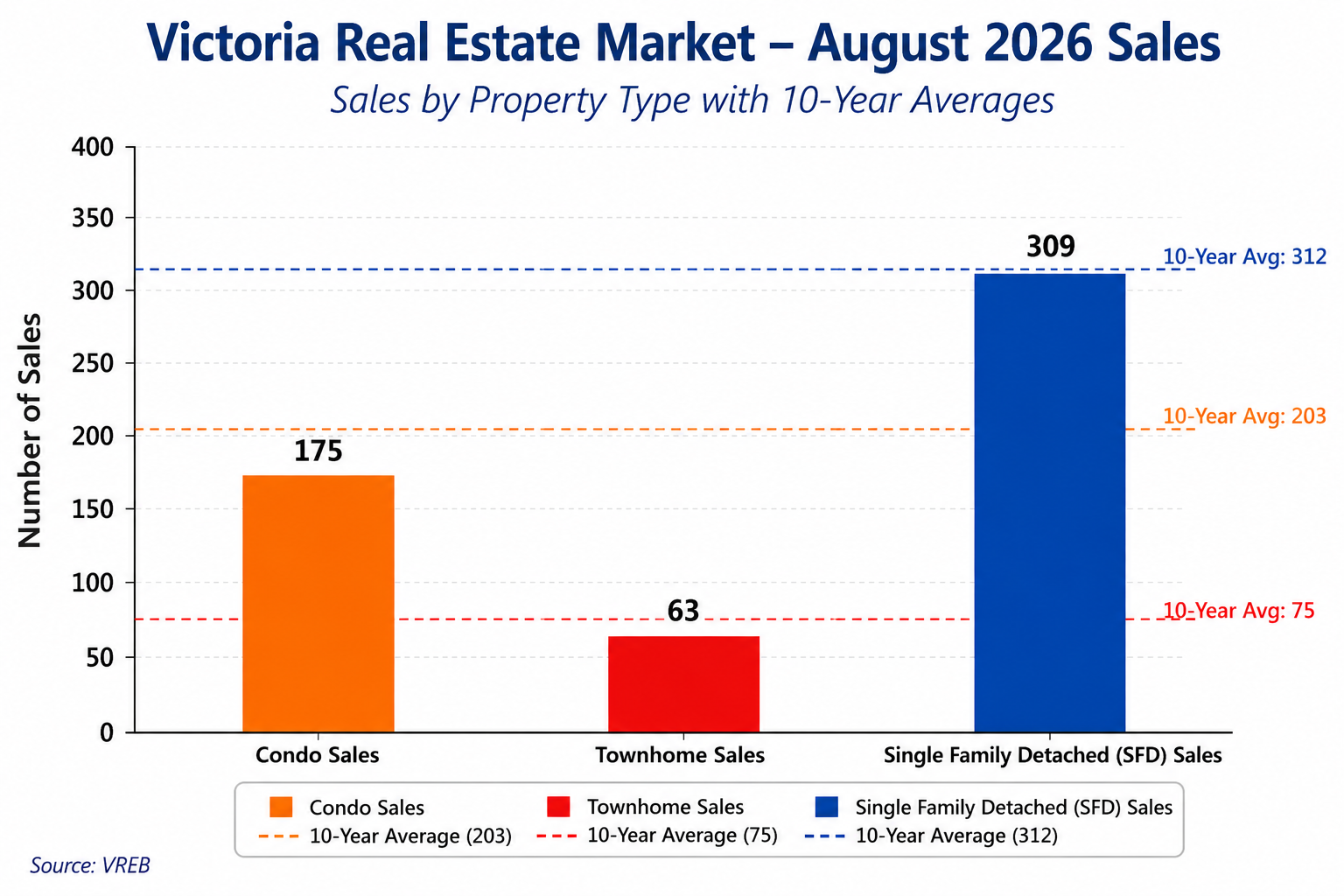
Perhaps the most encouraging statistic this month came from sales. For only the second time so far in 2026, residential sales increased on a year-over-year basis. A total of 567 residential properties sold in August; the highest total in 5 years. This represents an annual increase of 13.4%, which is a meaningful improvement.
However, as you will see in the chart above, the breakdown is important. Sales of single-family detached (SFD) homes showed considerably more strength than condos and townhomes. This continues a trend we've discussed over the past several months:
Detached Home Prices Show Strength
 Median Condo Price: $512,500
Down by 2.7%
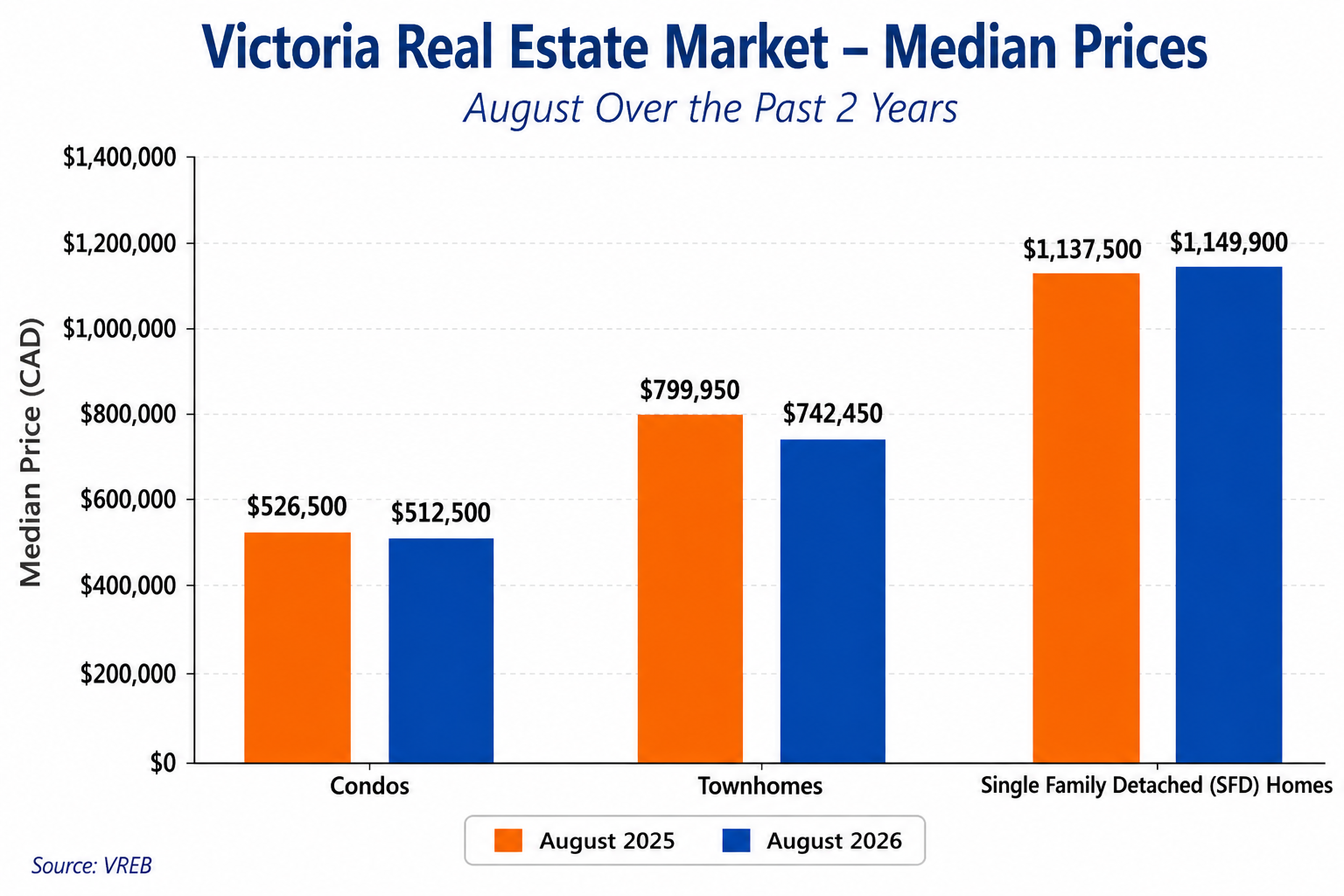
We're seeing a similar story when it comes to prices. The median price of a single-family detached home increased 1.1% compared to August 2025. Meanwhile, the median price of a condo declined 2.7%, while townhome prices fell 7.2% year over year.
Once again, the strength is clearly concentrated in detached homes. This is an important distinction for buyers and sellers. Someone selling a desirable detached home may be experiencing a very different market than someone trying to sell a condo or townhome—even though both properties are located within the same broader Victoria market.
Inventory Growth Has Slowed to a Crawl
 Median SFD House Price: $1,149,900
 Up by 1.1%
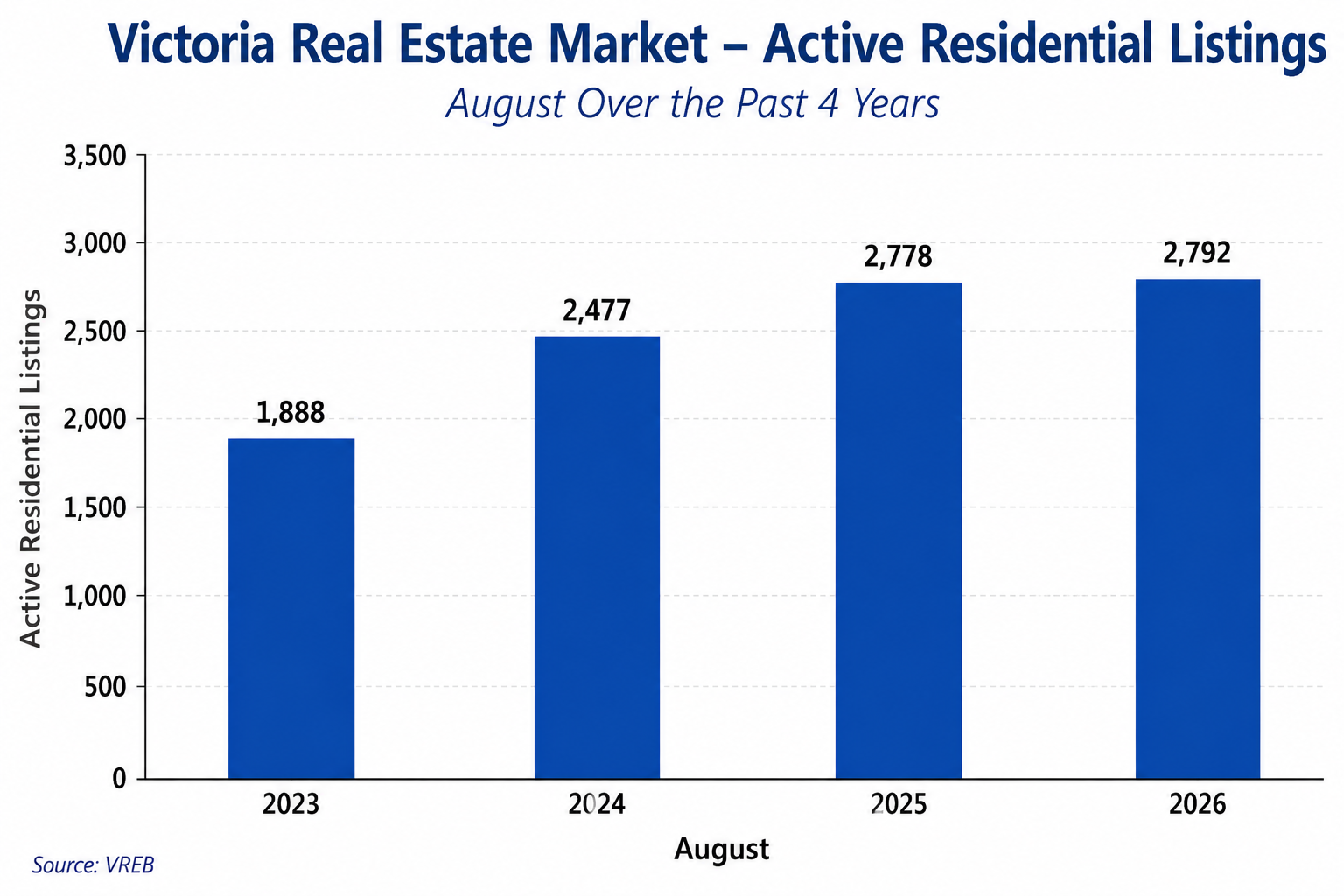
Last month, I highlighted a trend that I thought was worth watching: inventory was beginning to plateau. That trend continued in August. There were 2,792 active residential listings at the end of the month, compared with 2,778 at the same time last year. Technically, inventory increased—but by just 0.5% year over year.
As you will see in the above chart, that's a minuscule increase compared with the inventory growth we've experienced over the past few years. In other words, the supply of homes for sale is no longer expanding at anything close to the pace it once was.
If this trend continues, we could soon reach the point where active inventory actually begins declining on an annual basis. Combined with stronger sales, that would be an important development for the market.
Are We Finally Seeing the Market Turn?
There are some genuinely encouraging signs this month: Sales are increasing. Inventory growth has almost completely stalled. And detached home prices are showing some resilience.
But I don't think we can declare that the entire Victoria real estate market has turned the corner just yet. The strength we're seeing is disproportionately concentrated in single-family detached homes. Condos and townhomes remain considerably weaker, particularly when we look at their year-over-year price performance.
So the question I'm watching now is whether strength in the detached market eventually spills over into other segments. Perhaps improving confidence and activity in detached homes will translate into stronger condo and townhome sales in the months ahead. Or perhaps these markets will continue to move independently, with detached homes outperforming while condos and townhomes remain soft. Either way, August gave us something we haven't had much of lately: signs of genuine momentum.
I'll be watching closely to see whether that momentum continues—and I'll be back next month with another update.
 Months of Inventory: 4.9
= Balanced Market
Victoria Real Estate Market Report for September 2026
October 1, 2026 A total of 463 properties were sold in the Victoria Real Estate Board region this September, 16.4 per cent fewer than the 554 properties sold in September 2025 and 21.7 per cent fewer than August 2026. Sales of condominiums decreased by 11 per cent from September 2025, with 137 units sold. Sales of single family homes decreased by 17.3 per cent from September 2025, with 239 sold.
“September closed with inventory levels outpacing sales to a degree we haven’t seen in many years,” said Victoria Real Estate Board Chair Fergus Kyne. “The numbers indicate that the Victoria housing market has ventured into buyer’s market territory. Excluding the months from the start of the pandemic, this is the first time we’ve seen a buyer’s market since January 2015. However, one month does not make a trend, and it’s too early to say whether market conditions have shifted for the longer term. We’ll be watching the data closely over the coming months to see whether this is the beginning of a trend we haven’t experienced in more than a decade.”
There were 3,811 active listings for sale on the Victoria Real Estate Board Multiple Listing Service® at the end of September 2026, an increase of 4.1 per cent compared to the previous month of August and a 3.2 per cent increase from the 3,694 active listings for sale at the end of September 2025.
“There is a strong supply of inventory available in our market right now,” notes Chair Kyne. “But there is also a lack of certainty in many other aspects of our lives that may be contributing to lower sales activity. If you’re a qualified buyer and you’re looking for a new home, this might be a good time, because inventory generally decreases into the winter and your choices may not be as diverse as they are right now. For sellers, it’s important to have a conversation with your REALTOR® about the current market value of your specific property and how your expectations align with today’s market conditions in your market segment. September’s market looked very different from July and August, and conditions could shift again in October and the months ahead. That is why advice from a trusted local REALTOR® is so valuable when navigating a dynamic marketplace.”
The Multiple Listing Service® Home Price Index benchmark value for a single family home in the Victoria Core in September 2025 was $1,306,500. The benchmark value for the same home in September 2026 decreased by 2 per cent to $1,280,100, down from August’s value of $1,301,800. The MLS® HPI benchmark value for a condominium in the Victoria Core area in September 2025 was $542,200, while the benchmark value for the same condominium in September 2026 increased by 1 per cent to $547,800, down from the August value of $553,600.
View our press release and summary here.
View our complete statistical package here.
Notes for Interpreting Our Statistics
The use of sale price statistics can be useful in establishing trends when applied over a period of time, i.e. six months or longer. The Victoria Real Estate Board cautions, however, that such information does not indicate the actual value of any particular property. Those requiring specific information on property values should contact a REALTOR®.
The documents we link to on this page are stored in PDF format. If your browser already has a PDF plug-in like the Adobe Reader, you'll probably be able to simply click on the document you're interested in to view it here online. If not, you can download and install this popular, free software.
Courtesy of the Victoria Real Estate Board
Interpreting the Stats
 I believe that one of the best indicators to gauge the current real estate market is the sales-to-active listings ratio. Instead of just focusing on the number of sales we have in a given month, the sales-to-active listings ratio expresses the number of sales as a percentage of the active listings that are currently available for sale. In other words, current levels of demand relative to current levels of supply. For example, if we had a sales-to-active ratio of 50% this would mean that in the entire Victoria Real Estate Market we would have just 2 months of inventory for sale. In other words, if this level of sales were to continue, it would take only 2 months to sell all of the remaining listings on the market.
What does this mean for prices? Well, generally, less than 4 months of inventory indicates a seller's market with prices increasing more the lower that this number goes. On the other hand, more than 6 months of inventory generally results in a buyer's market with prices dropping. The longer the trend remains, the stronger the correlation to price increases/decreases. Interest rates, new building starts, wages and the state of the economy all have an effect, but essentially it is the amount of demand relative to inventory available for sale that drives the market.
- Caleb Mickelson